


How Local Initiatives and International Partnerships Supported Carpathian Communities in 2020–2025
Five Years of Change: Stories Made Possible Through Partnership
Where Change Begins with People
Since 2003, the Youth Public Environmental Organization “Our Home – Manyava” has been working with Carpathian communities, helping them find practical solutions in environmental education, environmental protection, health, and local development.
But this page is not the complete story of our organization.
This is the story of five years during which our work was especially difficult. Of the pandemic, the full-scale war, the forced displacement of people, educational losses, the need to support healthcare institutions, and, at the same time, not to lose faith in the future.
Behind every project implemented are people—their daily needs, concerns, and desire to improve life in their community. Reports usually retain budgets, indicators, and achieved results. But the story of why it all began is preserved far less often.
That is why this page is neither a list of grants nor a chronology of activities. It presents five stories about people, communities, and partners who worked together to create change during the most difficult period in Ukraine’s modern history.
In each of these stories, international support was an important part of the outcome. However, none of them began with a grant application.
Each story began with people who saw a problem and decided to take action.
Safe and Warm Conditions for the Youngest Residents of Verkhovyna


In the mountain settlement of Verkhovyna, the "Sonechko" Kindergarten serves local children. For many local families, it was the only accessible preschool where children could learn, develop, and interact with their peers, while parents could work and remain active members of the community.
The kindergarten building was constructed in 1972. Since then, it had not undergone any major renovation.
Over the years, the problems accumulated. Mould appeared on the ground floor, the flooring began to rot, the roof leaked, and significant heat loss was felt especially strongly in winter. For the mountain settlement of Verkhovyna, where the cold season lasts longer than in most regions of Ukraine, this was not simply a matter of comfort. It concerned the safety of the children and the kindergarten’s ability to operate fully.
The community leadership, the Department of Education, the kindergarten administration, and parents repeatedly raised the issue of repairs during the preparation of the district and settlement budgets. However, local resources were insufficient to provide a comprehensive solution.
Excerpt from the Official Appeal“The issues facing this institution have remained under the constant supervision of the district leadership and the Department of Education and are raised every year during the preparation of the district and settlement budgets. The facility was built in 1972. Since then, the building has not undergone any major renovation. Mould has appeared on the ground floor, causing the flooring to rot; the roof leaks, and there is significant heat loss during the winter. Unfortunately, due to a lack of funds, we are unable to resolve this problem.”
The situation was particularly difficult for the families of the children attending the kindergarten. Among them were 45 low-income families and 24 large families. Parents tried to support the institution, but their resources were insufficient for repairs on this scale.
Excerpt from the Official Appeal“Our institution is funded from the local budget, which mainly provides funding for protected expenditure items. To attract additional sources of funding, we participate in projects that help us address some of our problems. However, these funds are insufficient. The children’s parents provide charitable assistance, but most families whose children attend our kindergarten are low-income or have many children, so they are unable to provide us with further support.”
The path to solving the problem did not begin in 2020.
As early as 2017, during the implementation of the Slovak-Ukrainian project "Green Energy: Slovak-Ukrainian Experience," supported by SlovakAid, our organization worked with the Verkhovyna District on improving the energy efficiency of public institutions.
Together with our local partners, we assessed the condition of public institutions and developed recommendations for implementing energy-saving and energy-efficiency measures. Their implementation was intended not only to improve conditions for people using public facilities, but also, in the long term, to reduce local budget expenditure on heating and energy.
This work helped us better understand the scale of the problems facing the "Sonechko" Kindergarten and develop a well-founded solution. The next step was to find an international partner willing to support the community.
In 2020, with the support of the Government of Japan through the Embassy of Japan in Ukraine’s Grant Assistance for Grassroots Human Security Projects (GGP), the building underwent major renovation, creating safer, warmer, and more comfortable conditions for the children and staff.
The project was implemented during the COVID-19 pandemic. Quarantine restrictions, logistical challenges, and the distance of more than 200 kilometres between Manyava and Verkhovyna significantly complicated the work. Nevertheless, the project was completed, and the kindergarten gained the conditions the community had needed for many years.
During the project preparation stage, it was anticipated that the following groups would benefit directly from its implementation:
190 preschool children; 51 staff members; 88 families of enrolled children; at least 2,575 parents and relatives of the children.
As of May 2026, the project continues to benefit 192 children each year, including 101 boys and 91 girls. The kindergarten currently operates eight age-based groups.
The improved conditions are also used every day by 46 staff members, including 41 women and 5 men.
Thus, at least 238 people are direct annual beneficiaries of the project’s results: 192 children and 46 staff members. In addition, the project has a positive indirect impact on parents, children’s families, and the entire local community, as it helps maintain access to high-quality, safe preschool education services.
This story taught us an important lesson: a successful international project does not begin with a grant application.
It begins with understanding local needs, earning the community's trust, and doing consistent, long-term work.
When Children Became Nature Explorers

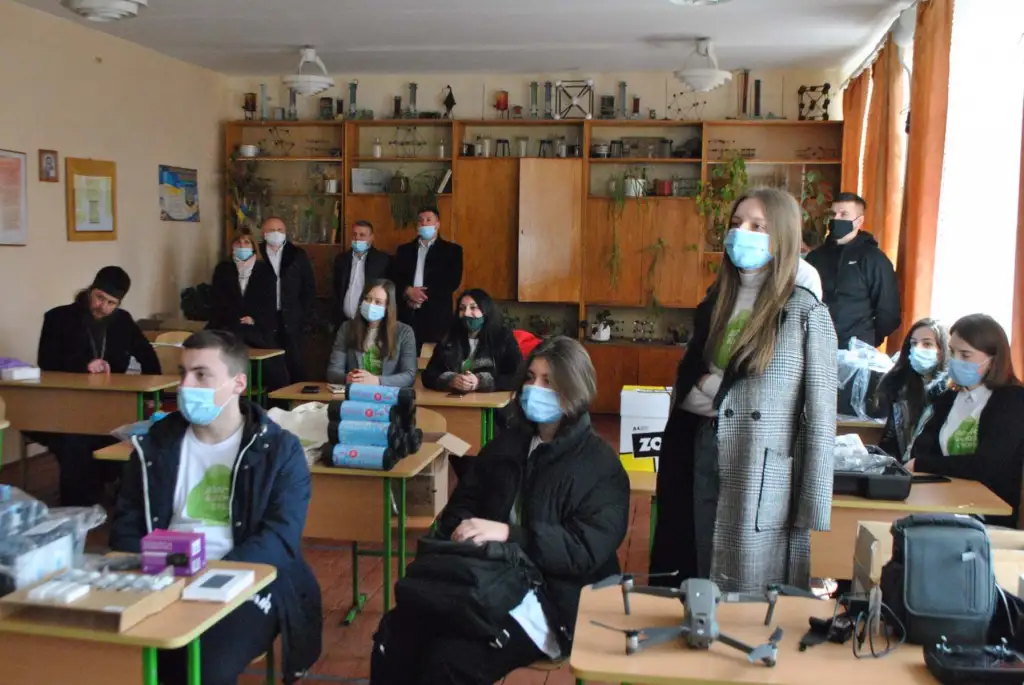
After addressing the infrastructure challenge, we returned to one of the core areas of our work—environmental education.
We increasingly realized that modern environmental education could not be limited to textbooks, presentations, or a few themed lessons. Children need more than simply learning about nature. They need to observe it, ask questions, carry out their own investigations, and understand how their everyday choices affect the environment.
This led to the launch of the EcoClass initiative, implemented with the support of the International Organization for Migration (IOM).
The initiative engaged approximately 150 unique participants and 8 teachers.
Children explored local ecosystems, studied natural features, made observations, learned to work in teams, and came to see environmental issues not as something distant and abstract, but as part of everyday life in their own community.
Learning was no longer confined to the classroom.
The forest, the river, the schoolyard, and the plants and animals around them became part of the learning environment. Children learned not simply to memorize facts, but to investigate, compare, ask questions, and search for answers.
For teachers, the initiative also provided an opportunity to explore new approaches to teaching—more interactive, practical, and closely connected to real life.
For many participants, it was their first experience of seeing nature not simply as a lesson topic, but as a place for discovery.
It was then that we were reminded once again that the best protectors of nature are not those who are simply told about environmental problems, but those who are given the opportunity to see, explore, and understand the world around them for themselves.
When We Had to Put Our Usual Work on Hold to Help People
On 24 February 2022, the lives of people across the entire country changed.
Like thousands of communities across Ukraine, we put our usual work on hold and focused on helping people who were forced to leave their homes because of the full-scale war.
It was March 2022—a time when no one knew what tomorrow would bring.
People arrived in Carpathian communities with very few belongings, sometimes after spending several days on the road. They needed food, hygiene supplies, clothing, a temporary place to stay, information, and the simple human reassurance that they were not alone.
During the first weeks of the full-scale invasion, we did not count people, boxes, or hours worked.
Our priority was simply to help as quickly as we could.
That is why, today, we do not want to estimate how many families received support. At that time, there was no comprehensive system for registration, monitoring, or reporting. Assistance was provided whenever people needed it—without unnecessary formalities.
Eight local volunteers, including young community members, joined the organization's response efforts.
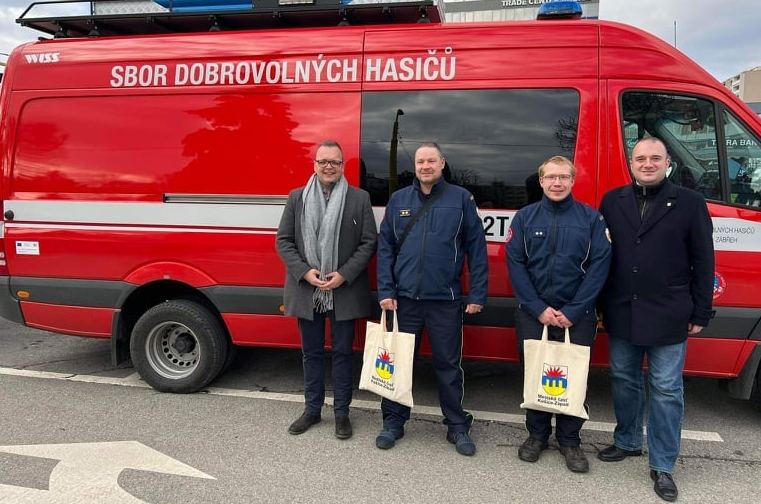
Together with our partners in Slovakia, we organized the collection, transportation, and distribution of humanitarian aid, supported people arriving in the community, coordinated volunteers, and responded to needs that changed almost every day.
“To us, they were not internally displaced people. They were people who needed help.”
This statement best reflects our approach during that period.
We did not want to see categories, statuses, or statistical groups. We saw people who had lost the lives they once knew and needed support.
The year 2022 was a test not only for Ukraine, but also for our organization. It taught us to make decisions quickly, work without complete information, adapt our usual ways of working, and take responsibility in situations that no one can fully prepare for.
At the same time, it revealed the strength of local solidarity.
Young people, volunteers, international partners, and members of the local community worked together because immediate help was needed.
From Recovery to a Stronger Organization
After the first months of the full-scale war, it became clear that good intentions alone were not enough to provide long-term support for people.
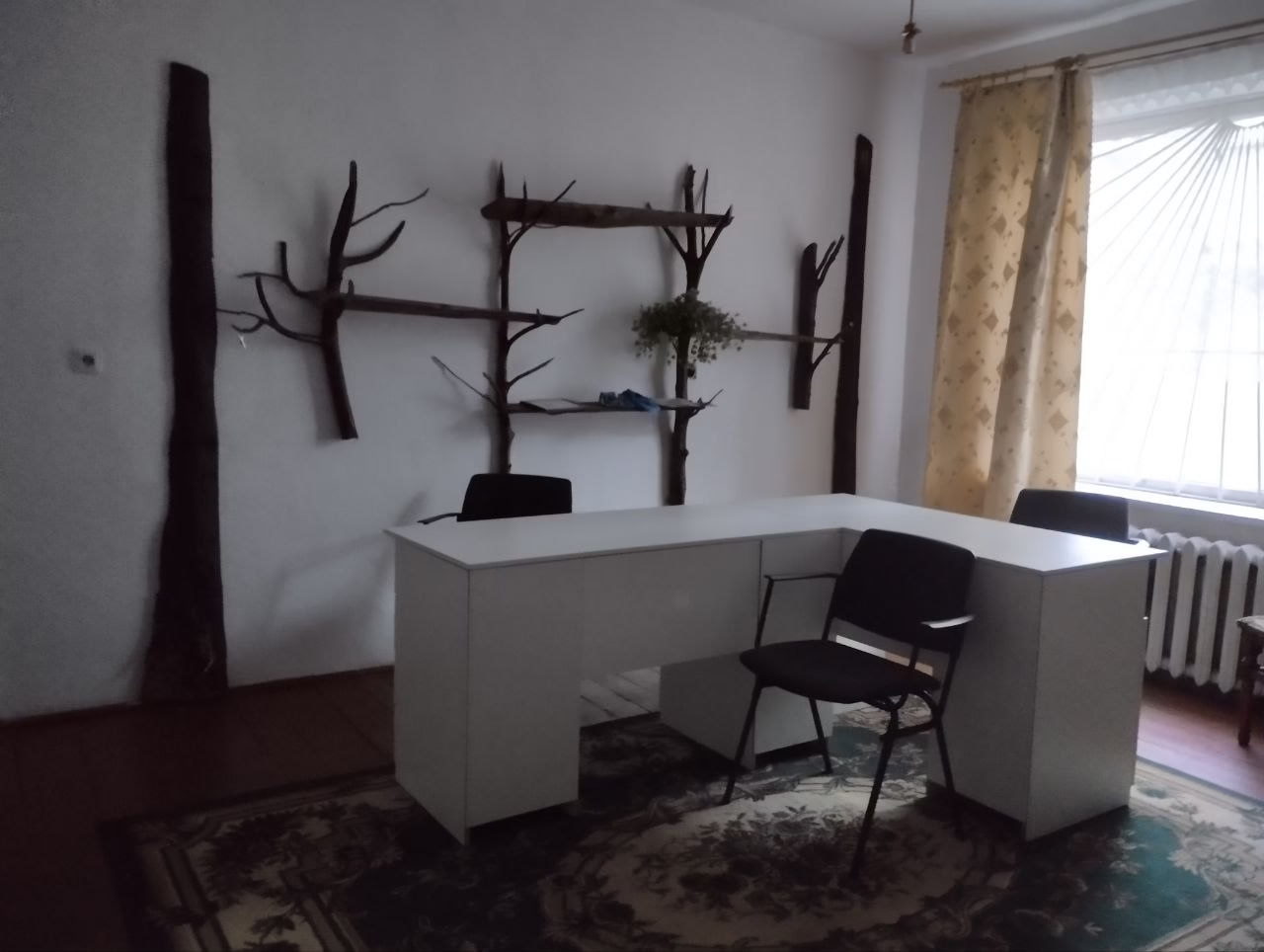
An organization must be able to work systematically—having the equipment, digital tools, space for its team and volunteers, the capacity to store data, hold meetings, prepare projects, and maintain communication with partners.
In 2023, with the support of Crown Agents, we strengthened the organizational capacity of the Youth Public Environmental Organization "Our Home – Manyava".
The support enabled us to improve the team’s technical working conditions, purchase the necessary equipment, strengthen our digital capacity, and create a more stable environment for our future work.
But the most important result was not the laptops or other equipment in themselves.
More importantly, it enabled us to continue our work.
To prepare new projects. To stay connected with communities and international partners. To coordinate volunteers. To preserve documents and the results of many years of work. To hold meetings and develop new initiatives.
This institutional support became the foundation for the next chapter of our story—the creation of a space that brought together books, environmental education, partnerships, and work with children.
The Library That Began with Children's Needs
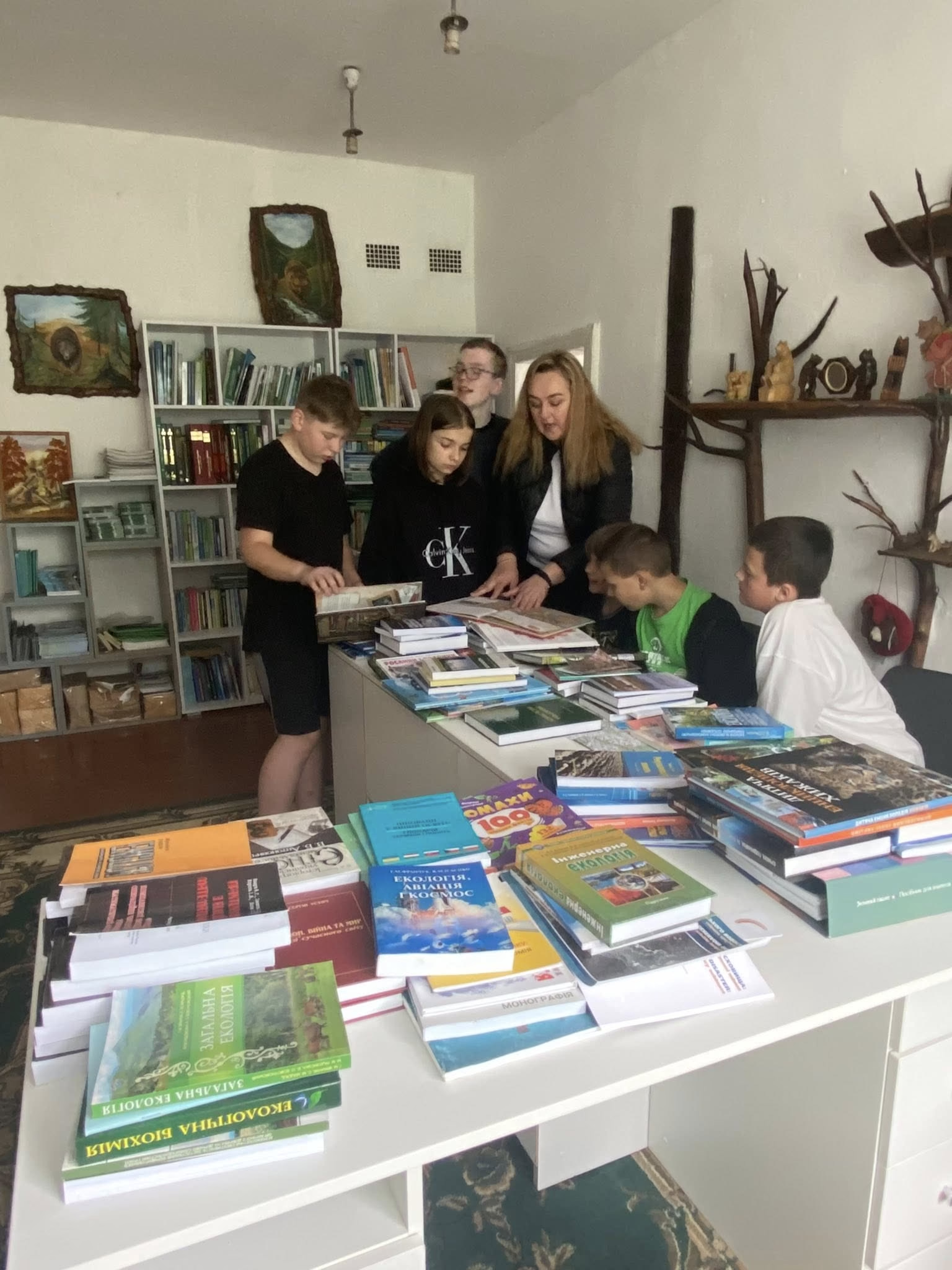
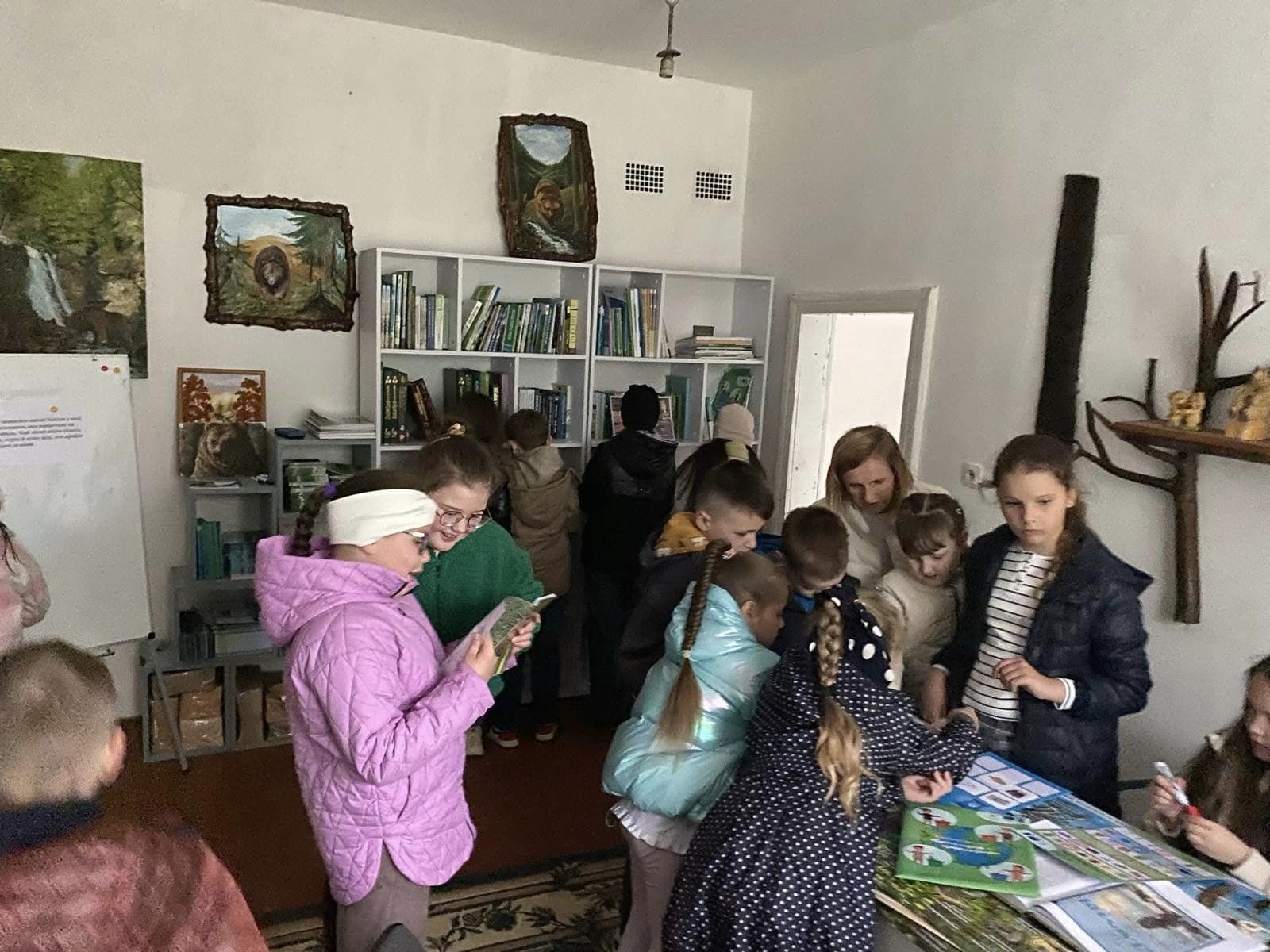
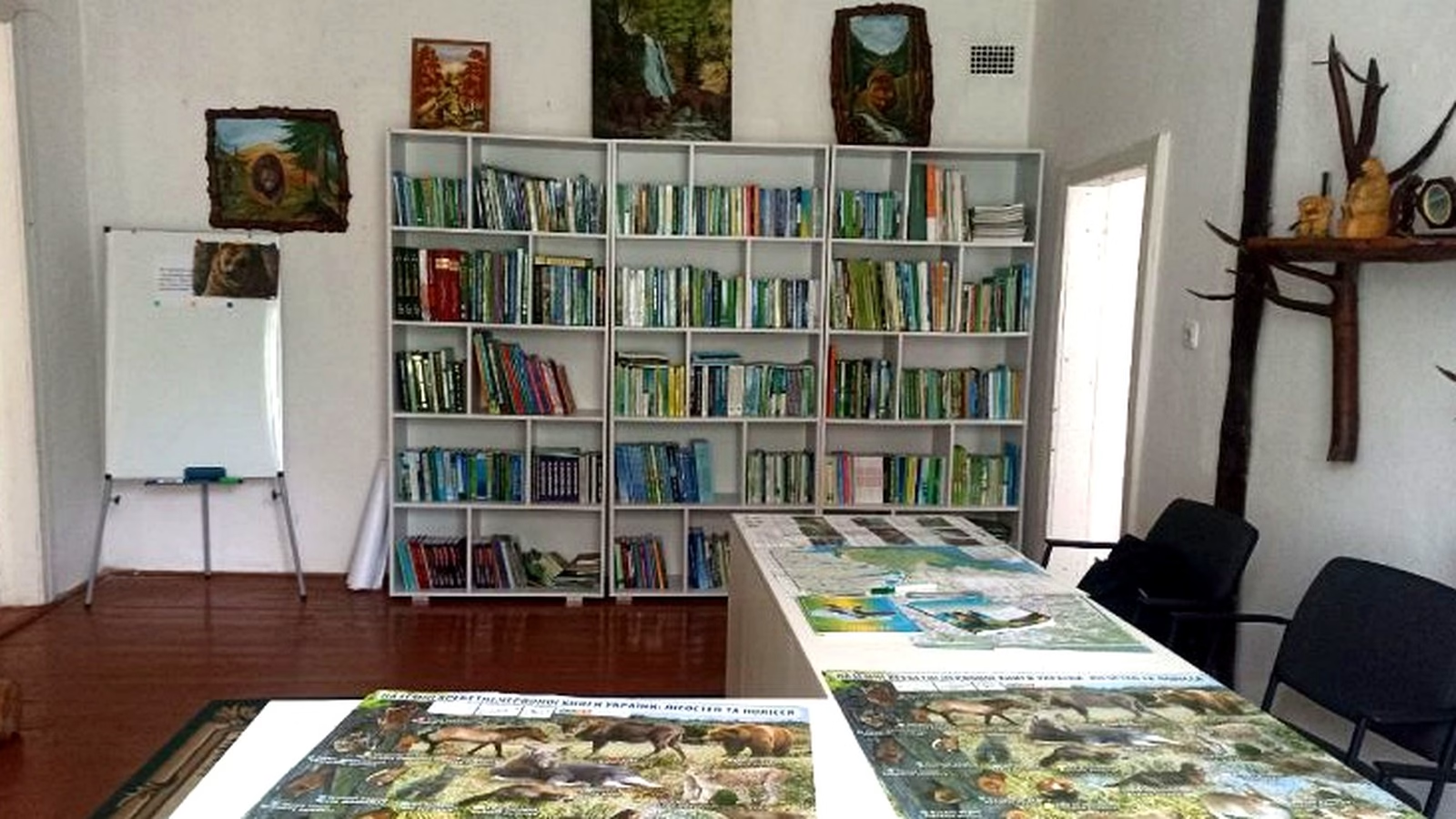
The idea for the Carpathian Environmental Library was not born in an office, nor did it begin with the announcement of a grant competition.
It began with conversations with children, teachers, and parents.
In rural areas, access to modern literature—especially high-quality books about nature, climate, wildlife, ecology, and sustainable development—remains limited. For many families, buying new books is a significant financial burden.
"I can't afford to buy new books for my children. But I want them to have the opportunity to read about nature, climate, and animals."
This need was voiced not only by parents.
Teachers also spoke about the lack of modern educational materials they could use in lessons, clubs, and extracurricular activities. Children wanted to read, explore new topics, and discover books that were not available in their school libraries.
That is how the idea emerged to create not just a library, but a specialized space for environmental education in a rural community.
The library grew thanks to the support of publishers, authors, civil society organizations, universities, partners, and caring individuals from across Ukraine.
By the end of 2023, the library's collection had grown to 1,450 books on environmental and natural science topics.
Every donated book was more than just another addition to the collection. It became an opportunity for a child to discover a new world, for a teacher to deliver a meaningful lesson, and for the community to create a space where knowledge is accessible regardless of a family's financial circumstances.
The next important milestone came with the support of The Pollination Project.
Thanks to the grant, the library received 212 new contemporary books. The project also included six interactive educational sessions, attended by approximately 150 children.
"For the first time, our students had the opportunity to see the new edition of the Red Data Book of Ukraine. For many of them, it was a truly eye-opening experience."
The new books made it possible to talk with children about nature not only through general concepts, but also through specific stories, plant and animal species, ecosystems, the threats they face, and ways to protect them.
Gradually, the library became more than just a place where books were stored.
It became a space for reading, meeting, learning, discussion, and the emergence of new environmental initiatives.
Children came here not only to borrow a book. They discussed what they had seen, shared their thoughts, asked questions, and came up with ideas of their own.
"Our library has become a place where children not only read, but also discuss the future of nature."
More than 50 partners contributed to the development of the library. As a result, it became an example of how a single local initiative can bring together people, organizations, and institutions around a shared goal.
Today, it is more than just a collection of books.
It provides a foundation for the further development of environmental education, youth engagement, educational activities, the creation of new educational programs, and the promotion of a culture of responsible attitudes toward nature.
"Children are our future and the drivers of change. If we invest in environmental education today, we help protect the Earth tomorrow."
This story once again confirmed that sometimes a major change begins with a very simple request: to give a child the opportunity to read a good book.
When Equipment Means a Chance at Life

Not every project can be measured by the number of books, educational sessions, or participants in educational programs.
Sometimes the greatest impact is measured by a chance at life.
The Ivano-Frankivsk Regional Perinatal Center provides care for newborns, including babies born prematurely or in critical condition who require intensive care.
In such situations, modern medical equipment can make the difference between life and death.
In 2025, with the support of the Government of Japan through the Kusanone Human Security Grant Assistance Program of the Embassy of Japan in Ukraine, the Perinatal Center received a modern AVEA mechanical ventilator, along with the necessary consumable supplies for its operation.
This equipment helps doctors support the breathing of newborns who cannot receive enough oxygen on their own and provide intensive medical care during a critical period in their lives.
We do not want to estimate how many children the ventilator may help each year without confirmed official data.
But we do know one thing for certain: when a newborn's life depends on the skill of the medical team and the availability of the right equipment, a ventilator like this can make all the difference.
"Saving the Lives of Ukraine's Smallest Patients"
These few words capture the central meaning of the project.
Not equipment for the sake of equipment.
Not a grant for the sake of reporting.
But an opportunity to give doctors a tool that helps them fight for the lives of their smallest patients.
Our Broader Impact
The five stories on this page span the years 2020–2025—one of the most challenging periods in our organization's work.
At the same time, they are part of a much longer journey that began in 2003.
Over the entire period of Our Home – Manyava's work:
Selected Results from the 2020–2025 Stories:
- 192 children benefit each year from the renovated kindergarten, while the improved conditions also support the daily work of 46 staff members.
- Around 150 children and 8 teachers participated in the EcoClass initiative.
- Eight local volunteers took part in humanitarian assistance efforts in 2022.
- By the end of 2023, 1,450 environmental books had been collected for the library.
- 212 new books were purchased with support from The Pollination Project.
- The Ivano-Frankivsk Regional Perinatal Center received an AVEA mechanical ventilator.
These figures matter.
But behind every figure is a real person: a child learning in a warm kindergarten; a student opening the Red Data Book of Ukraine for the first time; a family that received support during the first weeks of the war; a volunteer who did not stand aside; and a doctor who received a modern tool to help save newborn lives.
What These Five Years Have Taught Us
Across different stories — from renovating a kindergarten to helping save the lives of newborns — one pattern has remained clear: lasting change happens when local knowledge, community trust, and international support come together.
Starting with a Real Need
The best projects do not emerge from grant requirements alone. They begin with a careful understanding of what truly prevents people, institutions, and communities from moving forward.
Building Trust Before Submitting an Application
Partnerships with communities, teachers, doctors, volunteers, and local authorities are built over years. This trust is what makes future solutions realistic and grounded in real needs.
Combining Resources and Responsibility
Funding creates opportunities, but long-term results emerge only when all stakeholders share responsibility for achieving meaningful change.
Maintaining the Ability to Adapt
The pandemic and the war changed our plans, but not our mission. Our organization learned to quickly shift from planned activities to providing support where it was needed most.
Looking Beyond the End of a Grant
For us, results are not measured only by the equipment purchased or the activities delivered, but by how the solutions created continue to work years later and whom they continue to support.
Turning Experience into a System
Individual stories have given us the knowledge, partnerships, and confidence needed to move from local projects toward long-term programs for the Carpathian region.
Changes We Continue to Create Together
Five years have shown us that meaningful change begins with listening carefully to people’s needs, building mutual trust, and being ready to act together.
We are grateful to the communities, partners, volunteers, and donors who made these stories possible. We want to build the next stage together through partnership — creating stronger communities and a more resilient future for the Carpathian region.