


 When power outages disrupt lighting, computer equipment, communication, or basic devices, a community quickly realizes how important energy resilience is. That is why solar power stations for schools, hospitals, administrative buildings, and other critical infrastructure facilities are not only about saving electricity, but also about safety and the continuity of basic services for residents.
In 2026, solar power stations with a capacity of 5 kW are planned to be installed in the Dolyna, Halych, and Horodenka communities of Ivano-Frankivsk Oblast to provide backup power for critical and social infrastructure facilities.
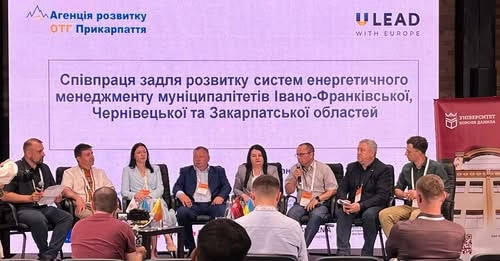
The initiative is being implemented within the international project “Cooperation for Community Energy Security,” which covers nine communities in Ivano-Frankivsk, Zakarpattia, and Chernivtsi oblasts. Approximately EUR 10,000 has been allocated for the purchase of equipment for Prykarpattia.
Each station will include solar panels, a hybrid inverter, and an energy storage system. This is not about fully powering large institutions, but about supporting the basic needs of a building during unstable electricity supply — lighting, computer equipment, communication tools, and selected equipment.
Project coordinator Mykhailo Ivashkiv emphasized that the main focus is not only on equipment, but also on developing the professional competencies of energy managers — people who will be able to assess community needs, identify priority facilities, plan energy consumption, and maintain the equipment. The project includes two five-day training modules in Ivano-Frankivsk, as well as the preparation of a joint application by the communities for participation in EU grant programmes.
The communities will independently determine the specific facilities where the stations will be installed. This is an important point: the choice should be based on the real needs of residents and the institution's role in crisis situations — for example, whether it is the only hospital in the community or a school that also serves as a shelter.
For Ivano-Frankivsk Oblast, such solutions are important not only in the context of wartime energy security. The Climate Change Adaptation Strategy, developed within the EU-funded APENA project, considers critical infrastructure, energy, public health, water resources, and the local economy as sectors sensitive to climate risks. Decentralized generation can be one of the practical tools for strengthening community resilience amid wartime challenges and growing climate threats.
Solar energy is actively developing in Prykarpattia: compared to the beginning of 2025, the number of industrial solar power plants has increased by 39%, while household solar systems have grown by 38%. Overall, the oblast has at least 7,500 distributed and small-scale generation facilities, including households. The Horodenka community, which has joined the project, is already one of the oblast’s leaders in the number of household solar power stations.
From the perspective of NGO “Our Home – Manyava,” the development of solar generation for critical infrastructure is a positive and timely step. To deliver real results, such solutions must be implemented responsibly: in line with the “do no harm” principle, with transparent selection of facilities, proper equipment maintenance, and long-term planning.
For the Carpathian region, small-scale solar generation is not only about electricity. It is about the ability of schools, hospitals, and other essential institutions to continue operating in difficult conditions, about people’s safety, and about a gradual transition toward climate-responsible development.
No responses yet