


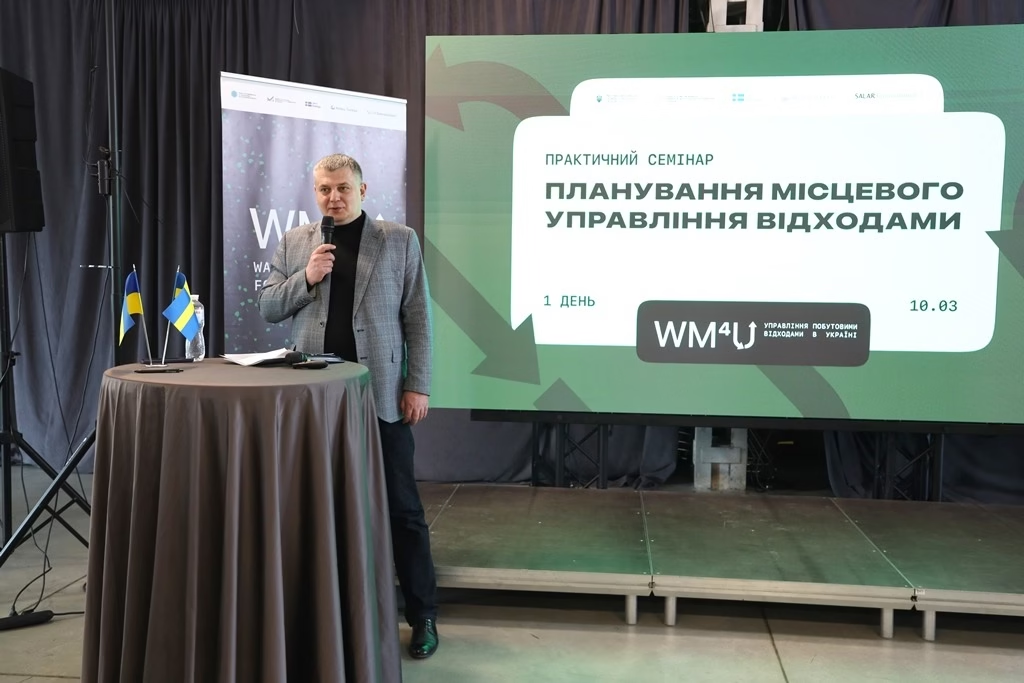
 The Ivano-Frankivsk Cluster has become one of four pilot clusters participating in the Swedish-Ukrainian WM4U programme, "Strengthening Municipal Waste Management in Ukraine (2024–2027)." Alongside Ivano-Frankivsk, the cluster-based approach is being implemented in Vinnytsia, Poltava, and Kharkiv regions.
On 15 July 2026, the Department of Ecology and Natural Resources of the Ivano-Frankivsk Regional State Administration announced its participation in a webinar dedicated to procedures for obtaining humanitarian assistance to support municipal waste management systems.
For local communities, the programme offers an opportunity to attract technical resources and equipment needed to improve waste collection, transportation, and treatment. For the mountainous areas of the Carpathians, however, strengthening waste management is also directly connected with the condition of small rivers and streams.
What the Programme Provides
WM4U is funded by the Government of Sweden through the Swedish International Development Cooperation Agency (Sida). The programme is implemented by Avfall Sverige in partnership with SALAR International.
The Ivano-Frankivsk Cluster brings together 19 territorial communities surrounding the regional centre. The cluster model enables neighbouring communities to jointly plan waste management systems, coordinate infrastructure investments, and more effectively attract international funding and technical assistance.
During the webinar, representatives of local authorities and communities received guidance on:
- national legal requirements governing humanitarian assistance;
- the role of Ukraine's Ministry for Communities and Territories Development in approving such assistance;
- cooperation with Swedish municipalities;
- customs clearance procedures;
- practical aspects of operating and maintaining donated equipment.
Accessing international assistance requires communities to clearly identify their needs, prepare the necessary documentation, complete approval procedures, and ensure the long-term management and maintenance of the received assets.
How Waste Reaches Small Rivers
Mountainous terrain, dispersed settlements, and long distances between villages make regular municipal waste collection particularly challenging in many parts of the Carpathians.
Where waste collection services are irregular or do not fully cover remote areas, household waste may accumulate in ravines, forests, roadside areas, and along the banks of rivers and streams.
During heavy rainfall and floods, which are common in mountain regions, part of this waste is washed into watercourses and carried downstream. As a result, what begins as a local waste management problem can become pollution affecting an entire river basin.
For small rivers, this creates several environmental pressures:
- physical pollution of river channels and banks with plastic and household waste;
- contamination of surface and groundwater from uncontrolled waste disposal sites;
- degradation of riparian ecosystems;
- additional obstacles to natural water flow, particularly in narrow channels and near bridges and culverts.
Improving municipal waste management is therefore not only about cleaner communities. It is also one of the most practical ways to prevent pollution of small rivers before it reaches larger river systems.
Environmental Monitoring Can Support Better Planning
When planning investments in waste containers, collection vehicles, transfer points, and other infrastructure, communities can benefit not only from demographic and waste generation data but also from environmental monitoring results
Information on littered riverbanks, illegal dumping sites, and locations where waste regularly accumulates can help identify priority areas where infrastructure investments are most urgently needed.
Combining waste management planning with monitoring of small rivers enables communities to move from responding to individual pollution incidents toward preventing pollution at the scale of entire river basins.
For international partners, this also demonstrates that community-based environmental monitoring has practical value beyond scientific observation. Monitoring data can inform infrastructure planning, support evidence-based decision-making, and strengthen the justification for investments in local waste management systems.
Sources: Department of Ecology and Natural Resources of the Ivano-Frankivsk Regional State Administration; Swedish-Ukrainian WM4U Programme.
No responses yet