


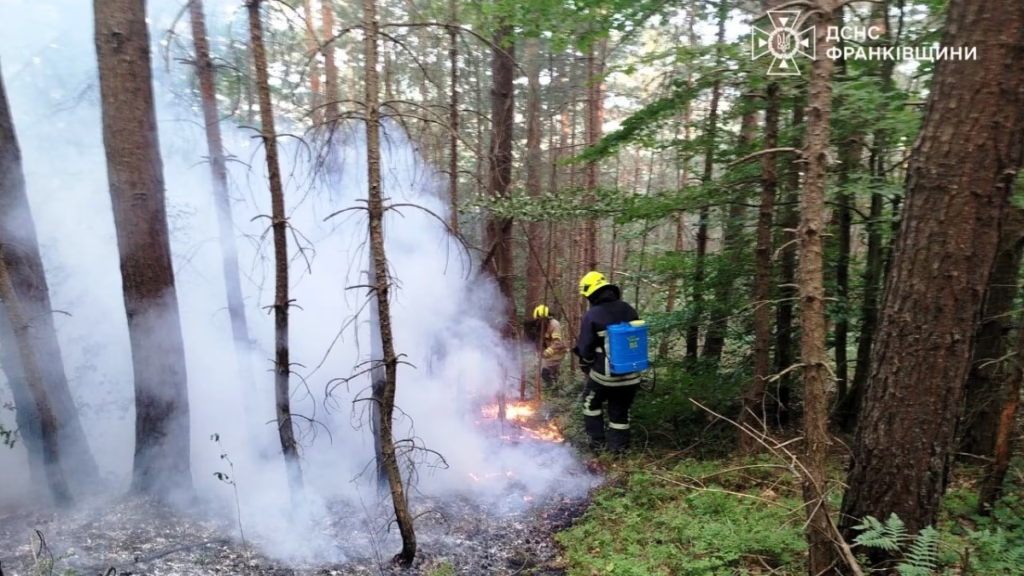
 Firefighters in Kalush District, Ivano-Frankivsk Region, have been working for a second consecutive day to extinguish a forest litter fire. The fire broke out on 5 July 2026 in a forested area near the village of Stankivtsi in the Vytvytsia Territorial Community.
According to the Main Department of the State Emergency Service of Ukraine in the Ivano-Frankivsk Region, the fire affected several areas totaling approximately 1,700 m². As of 6 July, two fire sites covering 700 m² had been fully extinguished, while the largest affected area of 1,000 m² had been contained, meaning that the spread of the fire had been stopped, although full extinguishing operations were still ongoing.
The response involved 31 firefighters, four units of specialized equipment, and forestry workers. A drone was used to monitor the boundaries of the affected area and support operational coordination. Wind gusts remained a major challenge for emergency crews, making it more difficult to predict the direction of the fire’s spread.
This was not the first fire in the region’s natural ecosystems in recent days. A peat fire had previously been reported near the village of Kolokolyn in the Bukachivtsi Community. These incidents highlight the ongoing seriousness of fire risks in the natural ecosystems of the Precarpathian region, particularly during dry, windy weather.
What Does a Forest Actually Lose During Such a Fire?
A forest fire is not only about visible flames or damaged trees. When forest litter burns, one of the first elements affected is the layer of fallen leaves, needles, mosses, small branches, and decomposing organic matter that forms a vital foundation of forest soil ecosystems.
This layer helps retain moisture, contributes to humus formation, and provides habitat for soil invertebrates, fungi, bacteria, and other microorganisms that sustain natural nutrient cycling. When forest litter burns away, the forest loses part of its natural protective layer: the soil can dry out more quickly, absorb water less effectively, and become more vulnerable to erosion during rainfall.
Fire also affects biodiversity. Some small animals, insects, larvae, fungi, mosses, and herbaceous plants may die directly during the fire. Other species may lose feeding areas, shelter, or breeding habitats.
Why Is This Particularly Dangerous for Carpathian Rivers?
In mountainous and foothill environments, forests perform essential water regulation and soil protection functions. They help retain precipitation, reduce rapid surface runoff, support groundwater recharge, and lessen peak pressures during intense rainfall. Scientific sources also emphasise that forests are particularly important for small rivers, whose ecosystems are generally less resilient to anthropogenic pressures than medium-sized and large rivers.
The mechanism is straightforward: in a healthy forest, a substantial share of rainfall does not immediately run off across the surface. Instead, it is intercepted and retained by vegetation, forest litter, and soil. When the litter layer burns, even across a relatively localised area, this “sponge-like” capacity is temporarily weakened. After heavy rainfall, water may move more rapidly downslope, carrying soil particles, ash, and organic material into nearby streams.
This is especially important during summer. Research into the effects of forest fires on aquatic ecosystems notes that peak fire activity often occurs in July and August and may coincide with periods of summer low flow, when small rivers naturally carry less water. At precisely this time, small watercourses may be particularly vulnerable to reduced natural water retention in their catchments and to additional pollution washed from affected slopes.
Another concern is the potential alteration of soil chemistry after fire. Scientific research examining the relationship between forest fires and heavy-metal contamination of soils indicates that fires may negatively affect soils, surface waters, biodiversity, and local microclimates. In one study, lead represented the greatest concern among the analysed metals. This does not mean that such contamination has already been identified at the specific fire site near Stankivtsi, but it demonstrates why post-fire soil conditions should be assessed not only visually but also from an ecological perspective.
Conclusion
Therefore, 1,700 m² of burned forest litter in Kalush District is more than a figure in an emergency response report. It represents a specific area of forest ecosystem that may temporarily lose part of its capacity to retain moisture, protect soil from erosion, and support the natural water regime of nearby streams and small rivers.
The Youth Public Environmental Organization “Our Home – Manyava” emphasises that after such fires, public discussion should focus not only on the size of the burned area but also on the ecological consequences for soils, biodiversity, catchments, and small Carpathian rivers.
Sources: Main Department of the State Emergency Service of Ukraine in Ivano-Frankivsk Region; scientific materials on the role of mountain forests in the water balance of the Ukrainian Carpathians; research on the impacts of forest fires on soils and small rivers..
No responses yet