


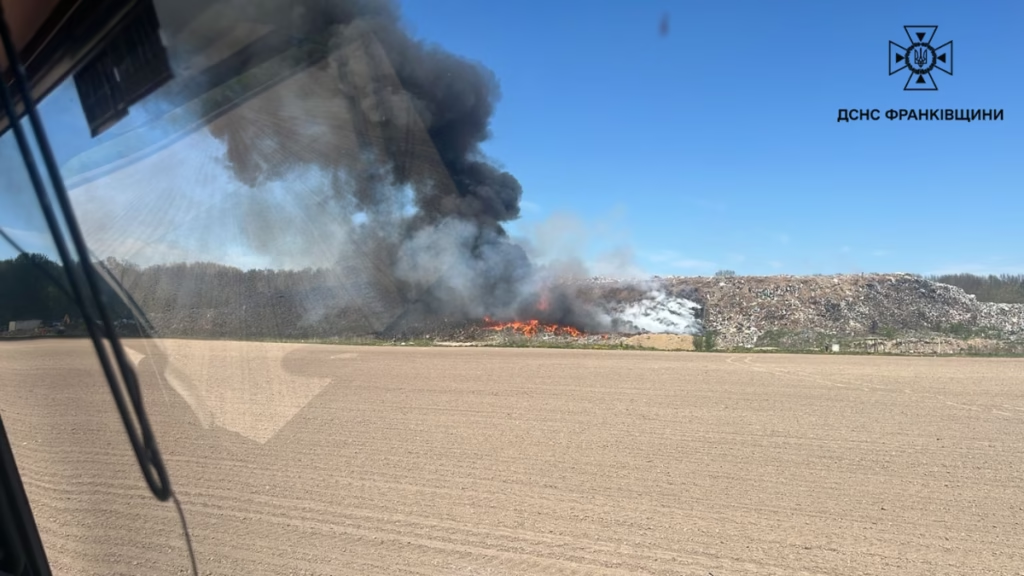
 At the beginning of May 2026, a large fire broke out at the solid household waste landfill near the Mochary area in the Starobohorodchany community of Ivano-Frankivsk Region. The incident attracted the attention of local residents, emergency services, environmental experts, and health specialists due to significant air pollution and potential environmental risks.
According to the State Emergency Service of Ukraine (DSNS), the fire started on May 4 and covered an area of approximately 300 square meters. Firefighters, local emergency teams, and specialized equipment were involved in extinguishing the fire. The blaze was localized after several hours, while smoldering continued into the following day.
According to the Ivano-Frankivsk Regional Center for Disease Control and Prevention, significant exceedances of harmful air pollutants were recorded near the landfill site.
In particular:
carbon monoxide (CO) concentration at the center of the fire reached 54 mg/m³, while the permissible level is 5 mg/m³;
at the entrance to the landfill — 32 mg/m³;
even at the boundary of the sanitary protection zone — 5.2 mg/m³.
Exceedances of nitrogen dioxide (NO₂) were also recorded:
near the fire source — 1.8 mg/m³ with a permissible level of 0.2 mg/m³;
at the landfill boundary — 0.22 mg/m³.
Specialists note that during the burning of mixed household waste, carbon monoxide, nitrogen oxides, particulate matter, and other hazardous compounds may be released into the atmosphere, negatively affecting human health and the environment.
At the same time, environmental experts emphasize that numerical exceedances often remain difficult for the general public to understand. For local communities, it is more important to recognize that such fires pose real risks to public health, air quality, water resources, and the overall environmental conditions of the region.
The issue of waste management in the Carpathian region is far broader than individual landfill fires. Every day, people generate significant amounts of household and organic waste that require collection, transportation, sorting, recycling, or safe disposal.
In practice, an effective waste management system should function as a circular cycle:
утворення відходів;
роздільний збір;
транспортування;
переробка;
повторне використання вторинної сировини.
This is how modern European waste management systems operate.
Despite the introduction of separate waste collection systems in many communities, a large proportion of waste still ends up at landfills. One of the key reasons is the lack of a fully developed infrastructure for:
сортування;
логістики;
переробки;
повторного використання вторинної сировини.
In many cases, even when separate waste containers are available, waste is ultimately mixed together and transported to landfills.
For mountainous territories, the problem is even more complicated due to remote settlements, difficult terrain, high transportation costs, and the limited number of enterprises capable of ensuring a full recycling cycle.
Another major challenge is the limited financial sustainability of businesses involved in waste collection and recycling. In Ivano-Frankivsk Region, there have already been initiatives focused on collecting separately sorted waste, but some of these projects were unable to continue operating due to economic difficulties and insufficient long-term support.
At the same time, warm and dry weather conditions increase the risk of fires at solid waste landfills, creating additional threats to both the environment and local communities.
Recently, the Integrated Waste Management Concept for the Dolyna Cluster was presented in Ivano-Frankivsk Region as part of the APENA 3 international technical assistance project. The concept includes developing separate waste collection systems, modernizing infrastructure, expanding recycling capacity, and implementing modern waste management approaches in line with European standards.
Such a cluster-based approach could become one of the possible directions for solving waste management challenges in other parts of the Carpathian region as well.
Comment by Mykola Skydaniuk, Head of the Youth Public Environmental Organization “Our Home – Manyava”:
“It is impossible to solve the waste problem in the Carpathian region solely through the creation of new clusters or the purchase of containers for separate waste collection. Alongside regional planning, it is essential to work directly with communities, households, and local residents.
For rural and mountainous areas, this issue is much more complex than for cities. Many villages have limited communal land resources, difficult terrain, high logistics costs, and a lack of infrastructure for proper waste recycling.
An important issue is the readiness of communities themselves for change. People need to understand how the system works, who will collect the waste, whether there are enterprises that will actually process recyclable materials, and how the cleanliness and operation of separate collection sites will be maintained.
Mountain communities require a comprehensive approach that combines environmental awareness, modern logistics, support for recycling businesses, and the financial capacity of local governments.
Local authorities, communities, and businesses must all participate in solving the problem. Without creating a complete system of collection, sorting, logistics, and recycling, even separate waste collection alone will not produce the expected results, and pressure on landfills will continue to increase.”
The fire at the Mochary landfill once again reminds us that waste management is not only a matter of public utilities but also an issue of environmental safety, public health, and the long-term sustainable development of Carpathian communities.
No responses yet